
This post contains affiliate links. If you buy through our links we may earn a small commission — at no extra cost to you. This never influences our recommendations.
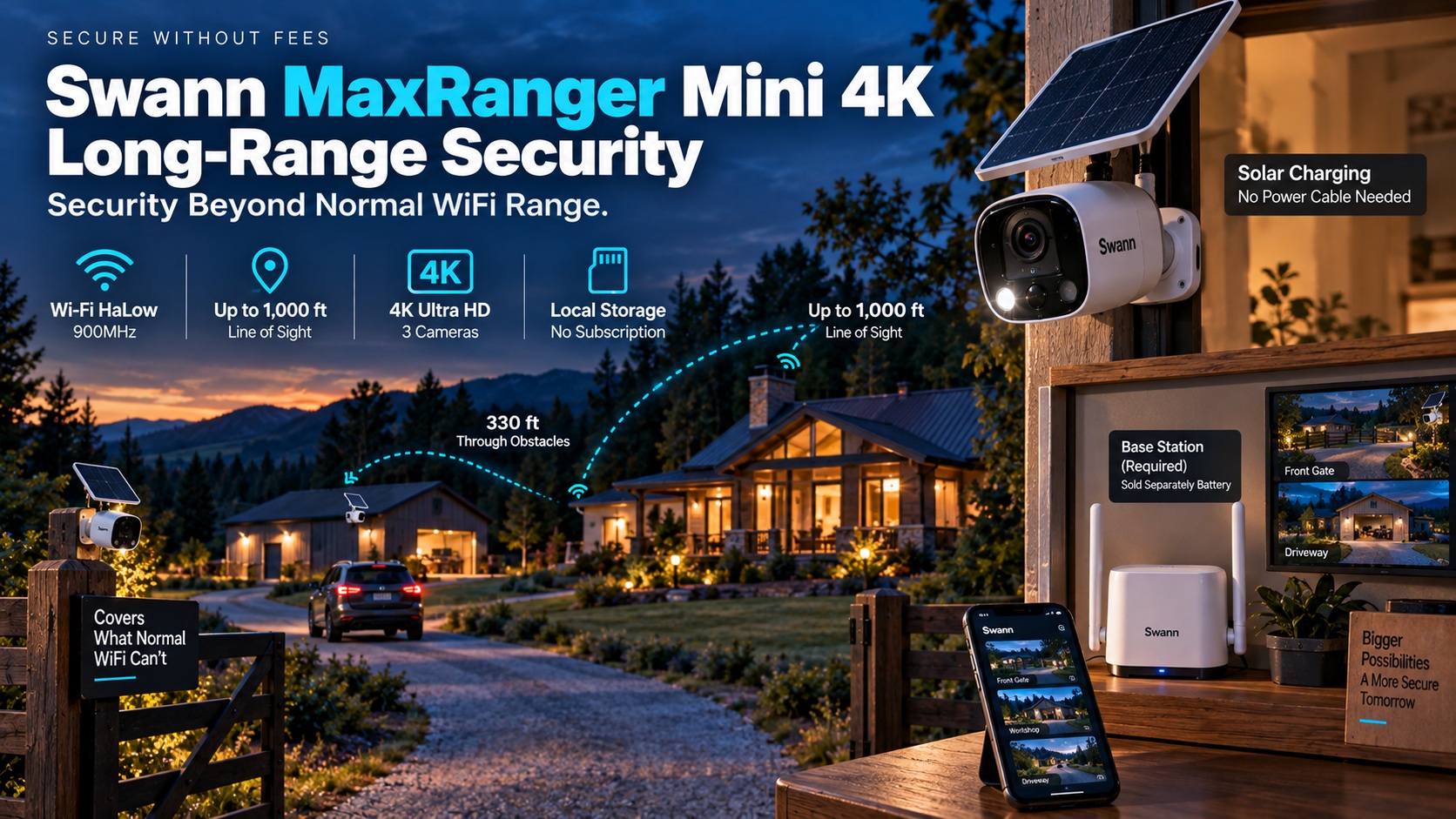
Most wireless cameras top out around 100-150 feet from their base station before signal starts dropping. The MaxRanger Mini does something different — it runs on Wi-Fi HaLow, a 900MHz signal built for long range, not your home’s regular 2.4GHz WiFi.
| Spec | Swann MaxRanger Mini 4K, 3-Pack |
|---|---|
| Resolution | 4K Ultra HD |
| Wireless tech | Wi-Fi HaLow (900MHz), not standard home WiFi |
| Range | Up to 1,000 ft line of sight, 330 ft through obstacles |
| Storage | Local microSD on the base station, no subscription |
| Recognition | Winner, “EFTM Best of CES” award, CES 2025 |
What Wi-Fi HaLow Actually Changes
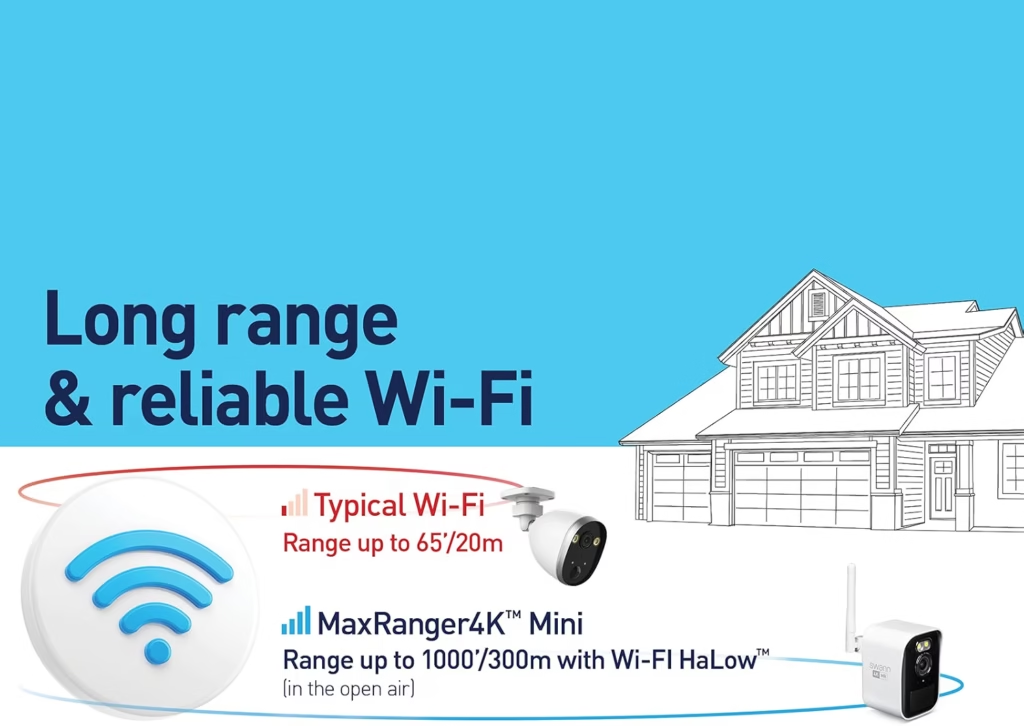
Standard WiFi cameras struggle once they’re a few rooms away from your router — walls, floors, and distance all cut into signal strength fast.
900MHz signals penetrate walls, ceilings, and trees far more effectively than the 2.4/5GHz bands regular WiFi cameras use, which is why Swann can advertise 1,000 feet in open air and still hold 330 feet through real obstacles.
One thing to understand clearly: this isn’t your home WiFi network extended further. It’s a dedicated, proprietary link between the cameras and the included base station — your router isn’t involved in that connection at all.
Genuinely No Subscription, With One Real Catch
The base station ships with local microSD storage already installed, and recording works with no monthly fee attached — consistent with Swann’s broader lineup.
The catch: a backup battery for the base station isn’t included. If your power goes out, the base station itself goes down unless you’ve bought that battery separately — worth factoring into the real cost if outage resilience matters to you.
Who This Actually Makes Sense For
The long range is the whole point here — covering a detached shed, a far fence line, or a driveway well beyond where a standard WiFi camera would even connect.
If your cameras are all going to sit within normal WiFi range of your router anyway, this is more range than you need, and a standard system will cost less for the same coverage.
Solar Charging Built In
The included cameras pair with a built-in solar panel Swann markets as “Forever Charged” — genuinely useful for cameras mounted far from an outlet, which is exactly where this system’s long range puts them.
That combination — long-range wireless plus solar-charged cameras — means you can realistically place a camera at the far edge of your property without running power or worrying about battery swaps.
| Pros | Cons |
|---|---|
| Genuinely long range — far beyond standard WiFi camera limits | Backup battery for the base station is sold separately |
| Local storage, no subscription required | Overkill if your cameras all sit within normal WiFi range anyway |
| 4K resolution with color night vision | Proprietary 900MHz link — not extending your existing home WiFi |
Best for: Larger properties with cameras positioned far from the house — sheds, distant fence lines, or driveways well outside normal WiFi range.
Swann MaxRanger Mini 4K Wireless NVR System, 3-Pack
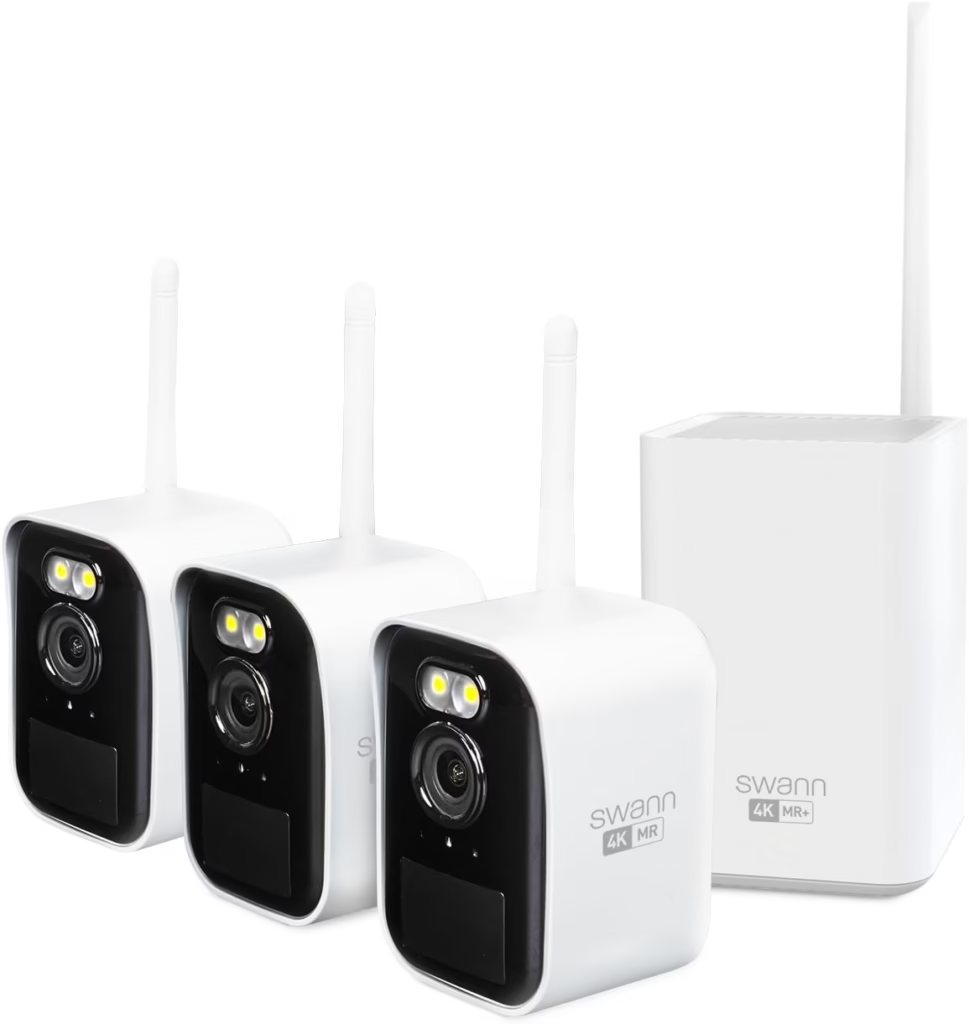
This is the kit built specifically for coverage a standard WiFi camera can’t reach — the long-range base station and three cameras are the whole point, not an incremental upgrade over a regular system.
Budget for the base station backup battery separately if losing power should never mean losing your recording.
Full details and current price: Swann MaxRanger Mini 4K, 3-Pack on Amazon
Frequently Asked Questions
Does the MaxRanger Mini use my home WiFi?
No — it runs on Wi-Fi HaLow, a separate 900MHz signal between the cameras and the included base station, independent of your router.
How far can the cameras actually be from the base station?
Up to 1,000 feet in open line of sight, or about 330 feet through walls and other obstacles in typical use.
Does it require a subscription?
No — recording saves locally to the base station’s microSD card with no monthly fee required.
What happens to the base station during a power outage?
It stops working unless you’ve purchased the backup battery separately — it’s not included by default.
Is this overkill for a typical suburban home?
Possibly — if your cameras would sit within normal WiFi range of your router anyway, a standard system covers the same ground for less.
Final Verdict
The MaxRanger Mini solves a specific problem — real coverage far from your house — better than almost anything else on the market. Just don’t buy it for a typical setup where a standard WiFi system would do the same job for less.