This post contains affiliate links. If you buy through our links we may earn a small commission — at no extra cost to you. This never influences our recommendations.
Schlage built its reputation over a century as one of the most trusted names in physical locks, and the Encode is where that legacy meets built-in WiFi and app control. This review covers the full spec sheet, what independent testing confirms about its reliability, and one meaningful feature gap between the standard Encode and its step-up sibling, the Encode Plus.
Full Specifications
| Spec | Schlage Encode |
|---|---|
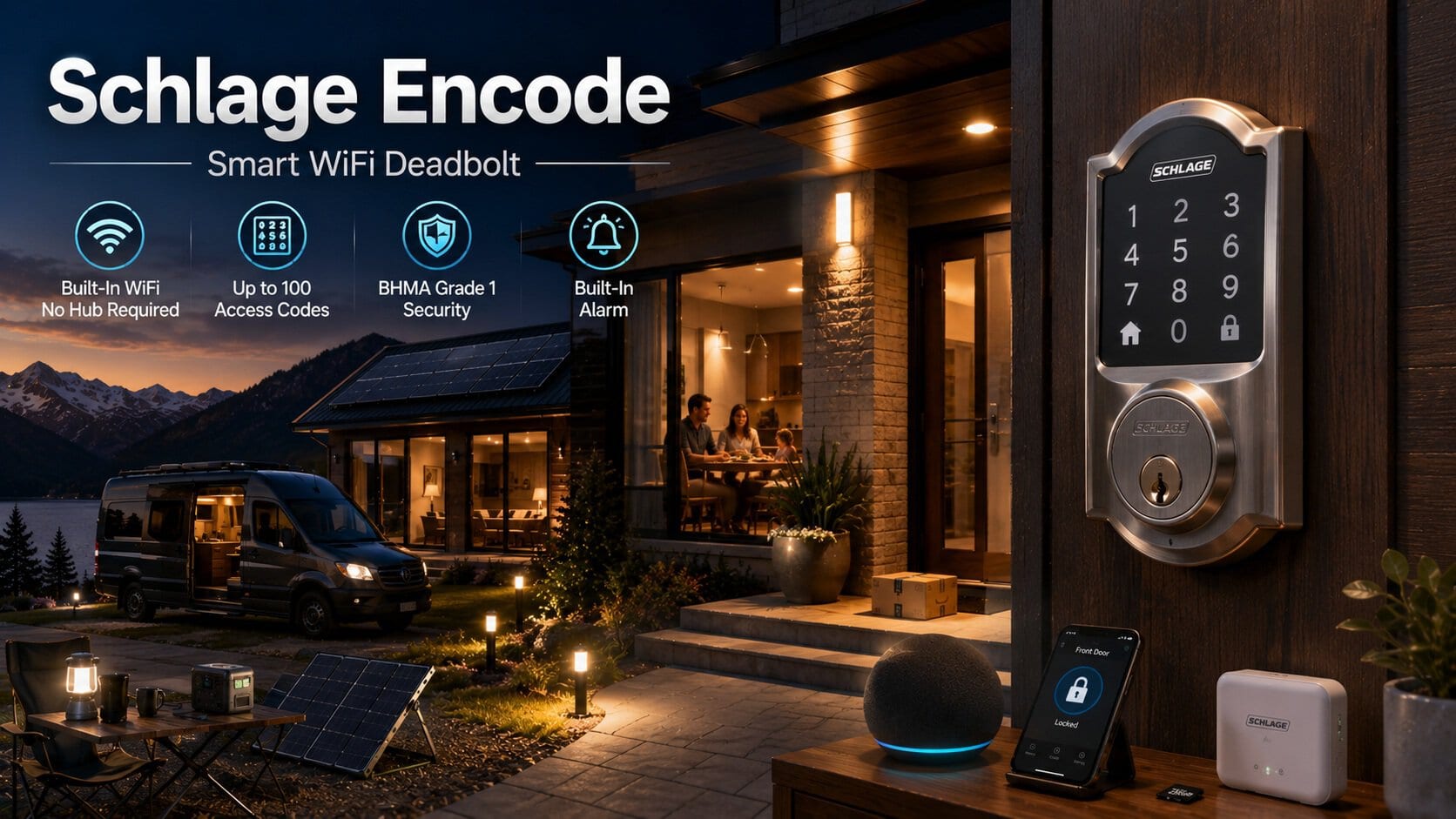
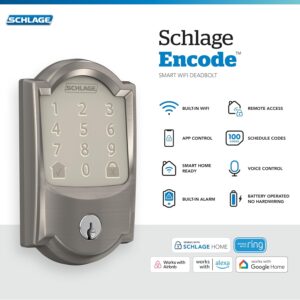
| Connectivity | Built-in WiFi — no hub or bridge required |
| Entry methods | Keypad codes (up to 100), app, physical key, voice assistant |
| Access code types | Permanent, recurring (scheduled), and temporary (date-range) codes |
| Security certification | BHMA Grade 1 — highest residential security, durability, and finish rating |
| Fingerprint entry | No — keypad and app only |
| Apple Home Key | No — this feature is exclusive to the step-up Encode Plus |
| Smart home support | Alexa, Google Assistant — no native Apple HomeKit on the base Encode |
| Built-in alarm | Yes — detects and alerts on forced entry attempts |
| Wi-Fi failure behavior | Falls back to local/Bluetooth operation — remains fully functional for entry even if Wi-Fi drops |
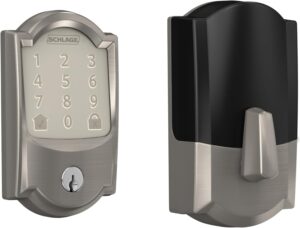
| Finishes available | Satin Nickel, Aged Bronze, Bright Chrome, Matte Black (styles: Camelot, Century) |
| Warranty | Limited lifetime warranty on mechanical design and finish |
| Price | Typically $200–230 |
Build Quality — Where Schlage’s Reputation Holds Up
Independent testing consistently confirms what a century of brand history would suggest: the Encode feels genuinely solid in daily use. One established reviewer specifically called it “durable and gorgeous,” noting the choice between Camelot’s traditional styling and Century’s cleaner modern lines gives real flexibility to match different door hardware and home styles. The BHMA Grade 1 certification — the highest residential security, durability, and finish rating available — isn’t just a marketing claim; it reflects standardized testing most competing smart locks don’t undergo or don’t pass at this tier.
Access Code Management — Built for Airbnb and Multi-User Households
The Encode’s 100-code capacity, split into permanent, recurring, and temporary categories, is genuinely well-suited to complex household or rental scenarios. Permanent codes work for family members or long-term tenants. Recurring codes let you set specific days and time windows — ideal for a regular house cleaner or dog walker who needs access only during set hours. Temporary codes with defined start and end dates are purpose-built for Airbnb guests or short-term visitors, expiring automatically without any manual cleanup required.
Independent host-focused reviews specifically praise this system, with one dedicated Airbnb review site scoring the Encode highly across Airbnb-specific criteria — native platform integration, remote access reliability, and ease of guest code management all factored into a strong overall rating for short-term rental use.
Wi-Fi Reliability — A Genuine Resilience Advantage
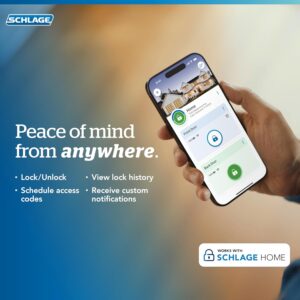
Built-in WiFi means no separate hub purchase, and testing confirms the connection performs reliably day to day, with one reviewer noting “near-instantaneous feedback” when locking or unlocking remotely through the app. Just as important: in the rare cases where Wi-Fi connectivity becomes unstable, the lock doesn’t fail — it simply falls back to local, Bluetooth-based operation. You lose remote access and instant notifications during that window, but the lock itself keeps working normally for anyone standing at the door. This is a genuinely reassuring design choice; a lock that becomes unusable during a Wi-Fi hiccup would be a serious problem, and the Encode specifically avoids that failure mode.
The One Real Gap: No Apple Home Key
This is worth being direct about, since it’s the most likely reason a buyer might second-guess the standard Encode. The step-up Encode Plus adds Apple Home Key support — tap-to-unlock functionality using an iPhone or Apple Watch, similar to a transit card. The standard Encode reviewed here does not have this feature. If you’re deep in the Apple ecosystem and specifically want that tap-to-unlock convenience, the Encode Plus is the model to look at instead. For everyone else — including Alexa and Google Assistant households — the standard Encode delivers essentially the same core experience (built-in WiFi, 100 codes, BHMA Grade 1 security, Airbnb integration) at a lower price.
Honest Pros and Cons
Pros: BHMA Grade 1 certification (highest residential rating), built-in WiFi with no hub required, genuinely resilient Wi-Fi failure handling (falls back to local operation rather than failing), 100-code capacity with flexible scheduling, strong Airbnb and short-term rental integration, limited lifetime warranty on mechanical design
Cons: No fingerprint entry, no native Apple HomeKit or Home Key support (available only on the pricier Encode Plus), premium price relative to some competitors’ base models
Who Should Buy the Schlage Encode
Best for:
- Airbnb hosts and property managers who need reliable scheduled access codes without ongoing manual management
- Alexa and Google Assistant households wanting built-in WiFi with no hub purchase
- Buyers who prioritize brand trust and proven physical security certification above biometric entry
- Anyone who wants confidence that a Wi-Fi hiccup won’t leave them locked out
Consider the Encode Plus instead if:
- You’re deep in the Apple ecosystem and specifically want tap-to-unlock via iPhone or Apple Watch
Consider a different lock entirely if:
- Fingerprint entry is a priority — see our best smart locks guide for fingerprint-capable alternatives
Frequently Asked Questions
What’s the difference between the Schlage Encode and Encode Plus?
The core difference is Apple Home Key support — the Encode Plus adds tap-to-unlock via iPhone or Apple Watch, a feature the standard Encode doesn’t have. Both models share built-in WiFi, 100-code capacity, and BHMA Grade 1 security certification. The standard Encode is the better value if Apple Home Key specifically isn’t a priority for you.
Does the Schlage Encode require a hub?
No — it has built-in WiFi and connects directly to your home network without any separate bridge or hub required, unlike some competing smart locks that need an additional purchase for remote access.
What happens if my Wi-Fi goes down?
The Encode falls back to local, Bluetooth-based operation, so the lock itself continues working normally for anyone at the door. You temporarily lose remote access and push notifications during the outage, but you’re never locked out due to a Wi-Fi issue.
Is the Schlage Encode good for Airbnb hosting?
Yes — it’s specifically well-regarded for this use case. The 100-code capacity with permanent, recurring, and temporary code types, native Airbnb platform integration, and remote code management make it one of the more consistently recommended locks for short-term rental hosts.
Does the Schlage Encode have fingerprint entry?
No — entry methods are limited to keypad codes, the app, physical key, and voice assistant commands. If fingerprint entry is a priority, see our best smart locks guide for alternatives that include biometric entry.
The Bottom Line
The Schlage Encode delivers on the brand’s century-long reputation for build quality and reliability — BHMA Grade 1 certification, genuinely resilient Wi-Fi failure handling, and a code management system well-suited to Airbnb hosts and multi-user households. The main trade-off is the lack of fingerprint entry and Apple Home Key, the latter reserved for the pricier Encode Plus. For most households — especially those using Alexa or Google Assistant, or anyone managing a rental property — the standard Encode remains a smart, trusted choice.
Check the Schlage Encode on Amazon →
For the full lineup of subscription-free smart locks, see our best smart locks guide. For whole-home security beyond the front door, see our best security cameras without subscription guide.