
This post contains affiliate links. If you buy through our links we may earn a small commission — at no extra cost to you. This never influences our recommendations.
Ring Protect runs $80–200 per year. Nest Aware runs roughly the same. Over five years, that’s $400–1,000 spent just to keep recordings you’d expect to own outright — often more than the doorbell itself cost. The good news: several brands now build genuinely capable video doorbells that store footage locally and deliver full functionality without a monthly fee attached to any core feature.
This guide covers what to check before buying, and the best subscription-free video doorbells available right now.
What “No Subscription” Actually Means for a Doorbell
A genuinely subscription-free video doorbell stores footage locally — on a microSD card in the doorbell itself, on built-in flash memory, or on a home hub — and delivers full functionality (motion detection, person/package alerts, live view, playback) without requiring payment. This is different from Ring’s approach, where most models require a subscription just to access recorded footage or basic smart alerts, even though the hardware itself doesn’t demand one upfront.
Confirm this before buying: some doorbells market themselves as subscription-free but gate smart detection features (like person vs. vehicle vs. package distinction) behind a paid tier, leaving only basic motion alerts free. Check the specific feature list against the local storage plan, not just the hardware description.
Wired vs Battery-Powered — Which to Choose
Battery-powered doorbells install without any existing doorbell wiring, making them the right choice for renters, apartments, or homes without a wired doorbell circuit. Battery life ranges from a few months to up to 8 months per charge depending on usage and model. The trade-off: periodic recharging, and typically motion-triggered rather than continuous recording to conserve battery.
Wired doorbells connect to existing low-voltage doorbell wiring (typically 8–24V) for constant power, enabling true 24/7 continuous recording rather than motion-triggered clips only. Several models in this category — including two of the picks below — support both wired and battery operation, giving you flexibility to choose based on your home’s wiring situation.
What to Check Before Buying
Storage type and capacity: Built-in storage (like eufy’s 8GB) works immediately with no extra purchase. MicroSD-based storage (Tapo, Reolink) requires buying a card separately but often supports higher capacities — up to 512GB on some models.
Field of view: Standard doorbells offer 160–180° horizontal viewing angles. Head-to-toe vertical framing (rather than just a face-level crop) matters for identifying package deliveries and full visitor views — check this specifically, since some wide-angle doorbells still crop the vertical frame awkwardly.
Dual-camera package detection: A second, downward-facing camera specifically for monitoring packages left at your door is a genuine practical feature, not just a spec-sheet bullet point — it directly addresses porch piracy in a way a single forward-facing camera can’t.
Smart home compatibility: Alexa and Google Home support is close to universal across subscription-free doorbells. Apple HomeKit support is rarer — confirm this specifically if you’re in the Apple ecosystem.
Chime included: Some doorbells include a physical or plug-in chime in the box; others require connecting to existing wiring or rely entirely on phone notifications. Check this if an audible in-home chime matters to you.
Best Video Doorbells Without Monthly Fees — Verified Picks
| Product | Resolution | Storage | Power | Best For |
|---|---|---|---|---|
| eufy Security E340 | 2K FHD, dual cameras | Built-in 8GB (expandable via HomeBase) | Wired or battery | Best overall |
| Tapo D225 | 2K QHD | microSD up to 512GB | Wired or battery (8-month life) | Best flexible install |
| Reolink Battery Doorbell 2nd Gen | 2K, 1:1 head-to-toe | microSD (local) | Battery | Best video quality |
Best Overall: eufy Security Video Doorbell E340
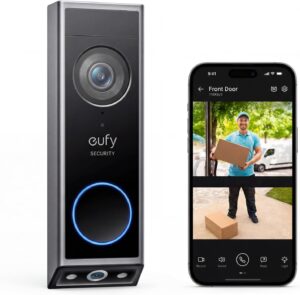
The E340’s dual-camera design is what sets it apart — a front-facing camera captures visitors head-to-toe while a second, downward-facing camera keeps a dedicated eye on packages left at your door. eufy’s “Delivery Guard” feature specifically alerts you the moment a package is dropped and if anyone approaches it afterward — a genuinely useful anti-theft feature that single-camera doorbells can’t replicate.
Built-in 8GB local storage means it works immediately out of the box with zero additional purchase — no subscription, no SD card required, saving over $120 per year compared to a typical cloud plan. For households wanting more storage or planning to add other eufy security devices, the doorbell is compatible with eufy’s HomeBase S380 hub, expandable up to 16TB. 2K Full HD resolution with color night vision (via eufy’s dual-light system) delivers clear identification even after dark. Works with Alexa and Google Assistant; note that it does not support Apple HomeKit.
Pros: Dual cameras with dedicated package monitoring, built-in 8GB storage (works immediately, no extra purchase), expandable to 16TB via HomeBase, color night vision, wired or battery flexibility
Cons: No Apple HomeKit support; 2.4GHz Wi-Fi only
Best for: Most households, especially anyone concerned about package theft or wanting a broader eufy security ecosystem
Best Flexible Install: Tapo D225
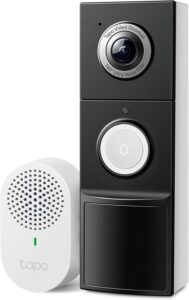
The Tapo D225 offers genuine installation flexibility that most doorbells don’t: hardwire it via existing 8–24V doorbell wiring for true 24/7 continuous recording, or run it entirely on the built-in 10,000mAh battery for up to 8 months between charges. That’s a meaningfully larger battery than most competitors in this category, translating directly to less maintenance.
2K QHD resolution with a 180° head-to-toe field of view eliminates the blind spots that plague narrower doorbells, and full-color night vision keeps footage useful after dark. AI detection distinguishes people, packages, and vehicles specifically — not just generic motion — which cuts down on false alerts from passing cars or blowing leaves. Storage runs via microSD card up to 512GB (not included, buy separately), with AES 128-bit encryption protecting stored footage. Works with Alexa and Google Assistant.
Pros: Wired or battery flexibility with genuinely long 8-month battery life, 2K QHD resolution, 180° head-to-toe view, person/package/vehicle AI detection, up to 512GB microSD support
Cons: MicroSD card sold separately; 2.4GHz Wi-Fi only, no 5GHz support
Best for: Buyers who want the choice between wired continuous recording and flexible battery installation
Best Video Quality: Reolink Battery Video Doorbell (2nd Gen)
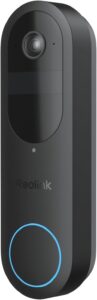
Reolink’s 2nd Gen doorbell distinguishes itself with a genuine 1:1 head-to-toe aspect ratio (150°×150°×180°) — rather than a standard widescreen crop that cuts off the top or bottom of a visitor’s frame, this doorbell captures the full vertical view most people actually want from a front-door camera. Dual-band 2.4/5GHz Wi-Fi support gives more reliable connectivity than the 2.4GHz-only competitors in this category, particularly useful in homes with congested Wi-Fi environments. Battery life is rated up to 10 months per charge — a meaningful jump over the first-generation model’s 5-month rating.
Person, vehicle, animal, and package detection all work without a subscription, and new anti-tamper alerts plus voice-changing two-way talk add genuine privacy and security upgrades over the original. The doorbell integrates with Reolink’s broader ecosystem — Reolink Home Hub, Chime Plus, and Google Assistant/IFTTT — for households already invested in or considering Reolink’s camera lineup (including the outdoor cameras covered in our best security cameras guide). Local storage supports up to 512GB microSD, Reolink Home Hub, NVR, or FTP/NAS, all with no monthly fee.
Pros: True 1:1 head-to-toe aspect ratio, dual-band Wi-Fi, up to 10-month battery life, anti-tamper alerts, full AI detection suite included free
Cons: No chime included; only compatible with Reolink’s newer Chime Plus (not the original Reolink Chime or most third-party mechanical chimes)
Best for: Reolink camera owners, homes with Wi-Fi congestion issues, anyone who wants the most natural full-body framing and long battery life
The Real Cost Comparison
A subscription-free doorbell in the $60–130 range costs exactly that over its entire lifespan — no recurring payment, ever. A comparable Ring doorbell plus Ring Protect Plus (roughly $10/month or $100/year) totals $400–600 over five years for equivalent smart features and video history. The math consistently favors local storage for anyone keeping a doorbell longer than 12–18 months.
Frequently Asked Questions
Do subscription-free doorbells still send smart alerts?
Yes — all three doorbells in this guide include person, package, and (where applicable) vehicle detection as standard, free features, not paywalled add-ons. This is one area worth double-checking with any doorbell brand, since some competitors do lock smart detection behind a subscription even while marketing themselves as subscription-optional.
What happens to my footage if the doorbell is stolen?
For doorbells storing footage entirely on an internal microSD card or built-in memory, a stolen doorbell takes that footage with it. Hub-based systems (like eufy’s HomeBase) store recordings inside your home rather than in the doorbell itself, so footage survives even if the doorbell is physically removed — worth considering if doorbell theft is a specific concern in your area.
Can I use these doorbells with my existing chime?
The eufy E340 and Tapo D225 both support connecting to existing mechanical doorbell chimes when wired, in addition to app notifications and optional add-on smart chimes. The Reolink model’s base package doesn’t include a chime and may require a separate purchase for an audible in-home alert beyond phone notifications.
Do I need Wi-Fi for these doorbells to work?
Yes — all three require a home Wi-Fi connection for live viewing, remote notifications, and app access, even though recording itself happens locally. If your internet goes down, local recording continues uninterrupted, but remote viewing and instant phone alerts won’t work until connectivity is restored.
Which doorbell has the best battery life?
The Tapo D225’s 10,000mAh battery, rated for up to 8 months between charges, is the longest-lasting battery option among these three picks. Actual battery life varies with motion frequency, temperature, and Wi-Fi signal strength — high-traffic areas with frequent motion events will see shorter intervals between charges than the rated maximum.
Final Verdict
| Your Situation | Best Pick |
|---|---|
| Best overall, package theft concerns | eufy Security E340 (B0CD7NT4Y9) |
| Want wired or battery flexibility | Tapo D225 (B0D8MKQ5RC) |
| Best video framing, Wi-Fi congestion | Reolink Battery Video Doorbell 2nd Gen (B0FJDRFFQ6) |
For most households, the eufy Security E340 delivers the strongest overall package — dual cameras, built-in storage that works immediately, and genuine package-theft protection through its downward-facing camera. The Tapo D225 is the pick if installation flexibility matters most, and the Reolink doorbell is worth considering for its superior video framing and dual-band Wi-Fi, especially alongside other Reolink security cameras.
For whole-property coverage beyond the front door, see our best security cameras without subscription guide.