This post contains affiliate links. If you buy through our links we may earn a small commission — at no extra cost to you. This never influences our recommendations.
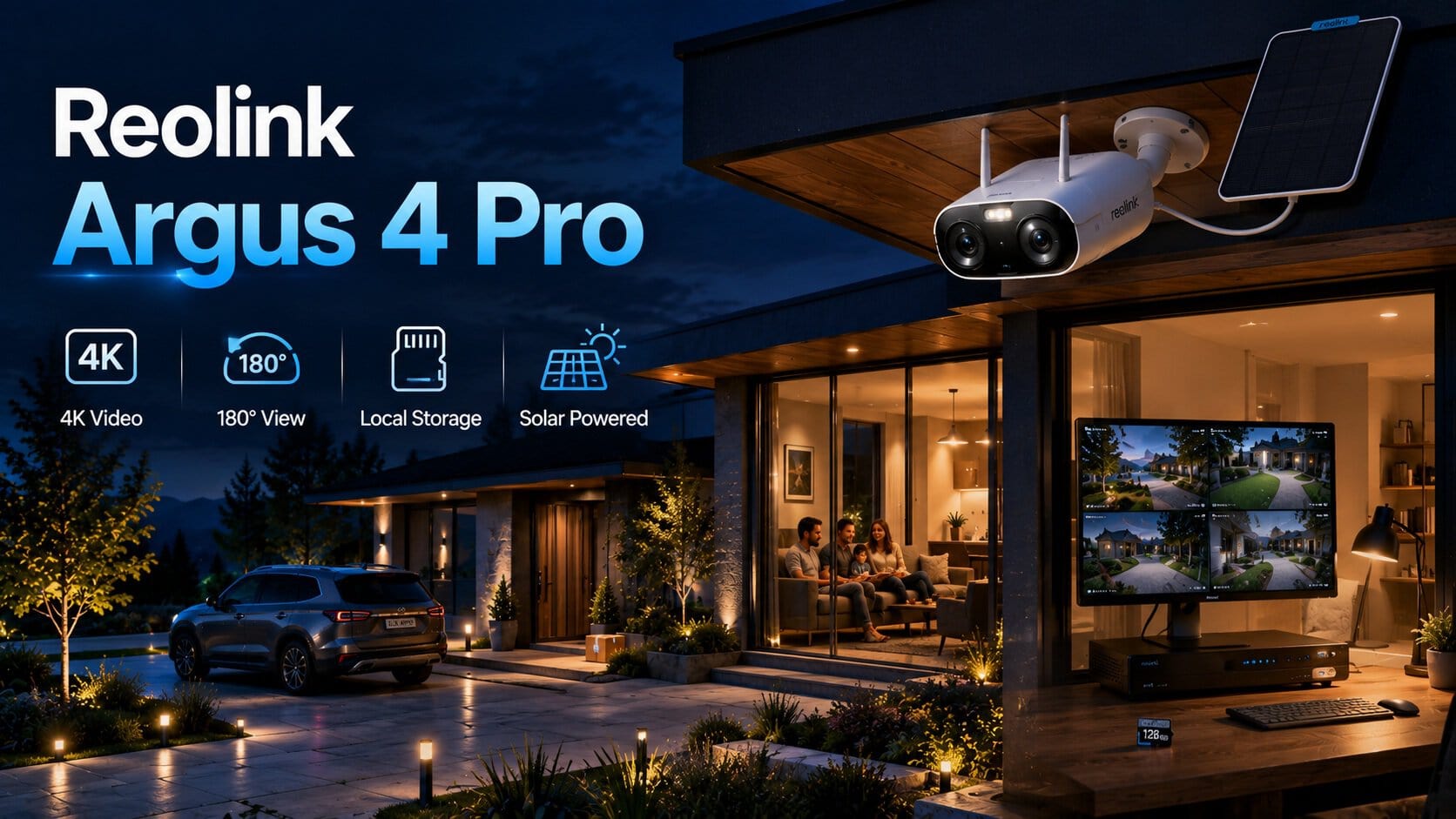
The Argus 4 Pro is the camera we recommend most often on this site — but “most recommended” shouldn’t mean “reviewed uncritically.” This review covers the full spec sheet, what independent testers found across multiple real installations, and two genuine weak points worth knowing before you buy: notification lag and cold-weather solar performance.
Full Specifications
| Spec | Reolink Argus 4 Pro |
|---|---|
| Resolution | 4K (8MP), dual-lens |
| Field of view | 180° stitched panoramic |
| Night vision | ColorVu/ColorX — usable color down to ~0.5 lux |
| Wi-Fi | Dual-band, 2.4GHz + 5GHz |
| Storage | MicroSD, up to 128GB (sold separately) |
| Detection | AI person/vehicle/animal, customizable zones and schedule |
| Battery | Removable rechargeable pack |
| Solar panel included | Reolink Solar Panel 2, 6W, USB-C connector |
| Two-way audio | Yes — built-in mic and speaker |
| Weatherproofing | IP65 or higher (outdoor rated) |
| Subscription required | No — full local storage functionality included free |
Image Quality — Where the Argus 4 Pro Genuinely Excels
The dual-lens 8MP setup stitching together a 180° field of view is a real practical advantage over single-lens competitors — one camera genuinely covers a wide driveway or backyard without the awkward fisheye distortion that wide-angle single lenses often produce. Independent testers consistently praised the image clarity, noting that textures, license plates, and facial details remain legible even during motion — a meaningful distinction from cameras that only look sharp in still, well-lit test shots.
ColorVu night vision holding usable color detail down to roughly 0.5 lux is genuinely impressive for this price point — most competitors in the $150–250 range still fall back to black-and-white infrared in near-total darkness, while the Argus 4 Pro continues rendering color, which meaningfully aids identification of clothing, vehicle color, and other details standard IR simply can’t capture.
AI Detection and Notifications — Solid With One Real Caveat
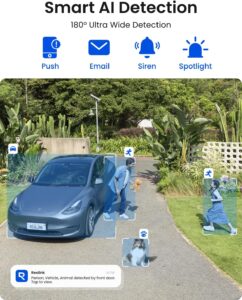
Person, vehicle, and animal detection all work reliably and reduce false alerts from the usual culprits — blowing branches, passing shadows, small animals. Non-detection zones and time-based scheduling give genuine control over exactly when and where the camera should trigger alerts, useful for excluding a busy street from vehicle detection while still monitoring a driveway or entry point.
The honest caveat: one thorough independent test measured push notification lag of 4–8 seconds behind the actual motion event. For general monitoring and after-the-fact review, this is a non-issue. For time-sensitive scenarios — specifically catching a package theft in progress, where those seconds matter — it’s a genuine limitation worth knowing about rather than discovering after the fact.
Solar Charging — Strong in Good Weather, Weak in Winter
The included Reolink Solar Panel 2 (6W) connects via USB-C and, in decent sunlight, performs well — one real-world test in Spain showed the panel taking the camera from 20% to 80% charge in just 3 hours, even on a cloudy day. In locations with consistent direct sun exposure, most users report the panel sustaining the camera’s charge indefinitely without manual intervention.
Where it genuinely struggles: a documented winter test in Iowa told a different story. Over 12 days with 8 cloudy days and temperatures ranging from -5°F to 22°F, the battery dropped from 100% to 34% despite the solar panel actively charging throughout. This is a meaningful data point for anyone in a northern climate or a region with extended winter cloud cover — the solar panel’s performance is genuinely weather- and location-dependent, not a guaranteed “never charge it again” solution year-round.
Important compatibility note: the Argus 4 Pro requires the newer Solar Panel 2 (6W) with a USB-C connector. The original Reolink Solar Panel (3W) uses a different connector and is not compatible — if you’re upgrading from an older Reolink camera, confirm you have the correct panel before assuming your existing one will work.
Storage and Subscription-Free Operation
The Argus 4 Pro records to a microSD card (up to 128GB, sold separately) with no hub or subscription required for full functionality — motion detection, AI person/vehicle recognition, and local playback all work completely free out of the box. This is the core reason it’s the anchor recommendation across this site’s security camera content. A removable battery pack is a genuine practical advantage over some sealed-battery competitors — own a second battery and you can swap a depleted one for a charged spare without waiting for a recharge cycle.
Honest Pros and Cons
Pros: True 4K dual-lens 180° coverage, genuinely impressive ColorVu night vision down to 0.5 lux, full AI detection with zero subscription requirement, removable battery for hot-swapping, dual-band Wi-Fi, solid image quality confirmed across multiple independent installations
Cons: 4–8 second notification lag in independent testing — not ideal for time-critical alerts like package theft, solar panel performance drops significantly in cold, cloudy winter conditions, microSD card sold separately, requires the newer Solar Panel 2 specifically (not backward compatible with older 3W panel)
Who Should Buy the Argus 4 Pro
Best for:
- Homeowners in climates with consistent sun exposure, where solar charging genuinely sustains the camera year-round
- Anyone wanting 4K image quality and true color night vision without a subscription
- Buyers who want a single camera to cover a wide driveway or yard without multiple fixed units
- Those who value swappable battery packs over waiting through a recharge cycle
Consider alternatives if:
- You live in a northern climate with extended winter cloud cover — plan for periodic manual charging rather than relying on solar alone through winter months
- Instant notifications matter more than general monitoring — the 4–8 second lag is worth weighing against faster-notifying competitors
- You want a hub-based system with expandable multi-terabyte storage — see our best security cameras without subscription guide for the eufyCam S3 Pro system as an alternative
Frequently Asked Questions
Does the Reolink Argus 4 Pro require a subscription?
No — every core feature, including AI person/vehicle detection, local microSD recording, and live viewing, works completely free with no subscription requirement. An optional cloud backup exists for those who want off-site storage, but it’s never required for full functionality.
How reliable is the solar panel in winter?
Less reliable than in summer or sunny climates. One documented winter test in Iowa showed the battery dropping from 100% to 34% over 12 days with 8 cloudy days and freezing temperatures, despite the solar panel actively charging. If you’re in a climate with extended winter cloud cover, plan to periodically check battery levels and manually recharge via USB-C rather than assuming the solar panel alone will sustain the camera through winter.
What’s the notification delay like on the Argus 4 Pro?
Independent testing measured push notifications arriving 4–8 seconds after the actual motion event. This is generally fine for reviewing what happened after the fact, but could matter in time-sensitive situations like catching a delivery theft as it happens rather than after the person has already left.
What size microSD card does the Argus 4 Pro support?
Up to 128GB, sold separately from the camera. A 128GB card typically holds several weeks of motion-triggered 4K footage depending on activity level in the monitored area.
Can I use my old Reolink solar panel with the Argus 4 Pro?
No — the Argus 4 Pro requires the newer Reolink Solar Panel 2 (6W), which uses a USB-C connector. The original Reolink Solar Panel (3W) uses a different, incompatible connector. Confirm you have the correct panel model before purchasing separately.
The Bottom Line
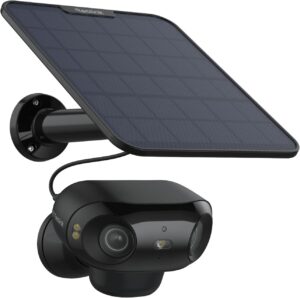
The Argus 4 Pro earns its position as our top security camera recommendation — genuinely excellent 4K image quality, true color night vision that outperforms most competitors at this price, and complete subscription-free operation. The honest caveats — notification lag and weather-dependent solar performance — don’t undermine the core value, but they’re worth planning around: keep expectations realistic for winter solar performance in northern climates, and don’t rely on this camera alone for split-second package-theft response.
Check the Reolink Argus 4 Pro on Amazon →
For the full lineup of subscription-free security cameras, see our best security cameras without subscription guide. For whole-property coverage with an NVR system instead, see our best NVR systems without subscription guide.