
This post contains affiliate links. If you buy through our links we may earn a small commission — at no extra cost to you. This never influences our recommendations.
Ring and eufy are the two most-searched names in DIY home security, and they represent genuinely opposite philosophies. Ring built a polished, Amazon-integrated ecosystem that leans on a subscription to unlock its best features. Eufy built its reputation on the opposite promise: local storage, no monthly fee, full functionality out of the box. This guide breaks down the real differences — including one honest trust issue eufy needs to answer for — so you can decide which approach actually fits your household.
The Core Difference: Storage Philosophy
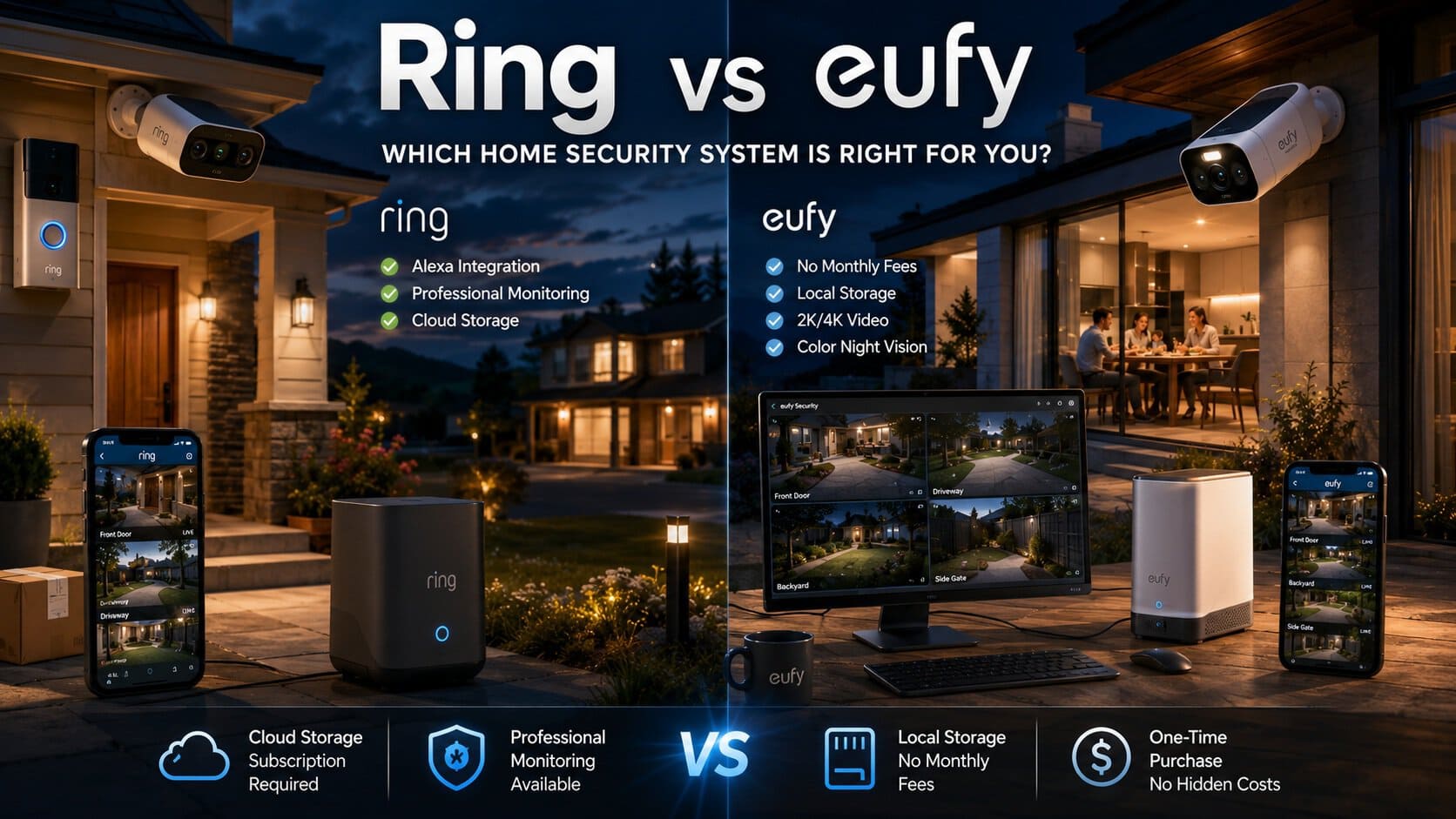
This is the single distinction that explains almost everything else in this comparison. Ring cameras and doorbells store footage in the cloud, and without an active Ring Protect subscription, most models are reduced to live-view-only — no recording, no video history, no person detection. Eufy cameras record locally by default, either to a built-in card or a HomeBase hub, with full functionality (recording, AI detection, playback) included at no ongoing cost.
Neither approach is objectively wrong — they’re built for different priorities. Ring’s cloud-first model makes sense if remote access from anywhere and Alexa integration matter more to you than avoiding a subscription. Eufy’s local-first model makes sense if you specifically want to own your footage and avoid recurring costs — which, given this site’s focus, is the more aligned approach for most readers here.
The Real Cost Difference Over Time
Upfront hardware pricing between the two brands is broadly similar. The gap opens up over time: multiple independent analyses estimate eufy saves roughly $270–$630 compared to Ring over a 3-year period for a typical multi-camera setup, once Ring Protect subscription costs are factored in. Ring’s subscription starts around $4.99/month per device or a whole-home plan covering multiple cameras — either way, it’s an ongoing cost eufy simply doesn’t have for equivalent functionality.
One detail worth flagging: Ring charges based on the number of devices under some plan structures, while eufy’s local storage model costs the same flat $0 recurring whether you have 1 camera or 12 — a meaningful advantage for anyone planning whole-property coverage.
Image Quality
Eufy generally holds a resolution advantage — most current eufy cameras shoot in 2K or 4K, compared to Ring’s 1080p on the majority of its lineup. In direct side-by-side testing, this translated to a tangible real-world difference: one comparison measured legible license plate detail at 22 feet with a 2K eufy camera versus only 15 feet with a 1080p Ring camera. Eufy’s color night vision is also available on more models without requiring a visible spotlight, while Ring’s color night vision options are more limited across its lineup.
Two-Way Audio and Response Time
In direct comparison testing, Ring showed a slight edge in audio latency — roughly a half-second delay versus eufy’s closer to one-second delay, making conversations feel marginally more natural through Ring’s system. Eufy’s speaker was reported as noticeably louder outdoors in the same test, which matters if the goal is audibly startling someone approaching your porch rather than just holding a conversation.
The Honest Trust Issue: Eufy’s 2022 Local Storage Controversy
This deserves direct, honest treatment rather than a footnote. In 2022, eufy was found to be transmitting camera thumbnail data to the cloud despite explicitly marketing its cameras as offering “100% local storage” with no cloud dependency. This was a genuine breach of the core promise eufy built its brand around, and it’s a legitimate reason for privacy-focused buyers to approach eufy’s marketing claims with some healthy skepticism rather than blind trust.
Eufy has since made changes in response, and no comparable incident has been widely reported since. But the trust damage is real, and it’s worth knowing before you buy into eufy’s local-storage promise uncritically. For buyers where absolute, verifiable local-only operation is non-negotiable, Reolink — covered throughout this site — is worth considering as an alternative with a comparatively cleaner privacy track record. See our Reolink Argus 4 Pro review for that option.
Where Ring Genuinely Wins
Alexa ecosystem integration: If your home already runs on Alexa, Ring’s integration is the smoothest and most native available — this is a real, non-trivial advantage for households already invested in that ecosystem.
Professional monitoring: Ring offers the option of professional monitoring with emergency dispatch through its higher-tier plans — a genuine safety net that eufy and most local-storage brands either don’t offer or offer in a much lighter form. For households that specifically want this layer of protection, it’s worth the subscription cost.
Broader lineup and accessories: Ring’s product range — doorbells, cameras, alarm system components, sensors — is broader and more mature than eufy’s, giving more flexibility for building out a complete whole-home alarm system in one ecosystem.
Cellular backup: Some Ring plans include cellular backup that keeps the system reporting even if home internet goes down — a feature local-storage brands generally don’t match.
Where Eufy Genuinely Wins
No per-camera subscription cost: Whether you have 1 camera or 12, eufy’s local storage cost stays flat at zero — a structural advantage for whole-property coverage that Ring’s per-device or whole-home subscription model can’t match over time.
Higher resolution across more of the lineup: 2K and 4K options are more common in eufy’s current catalog, compared to Ring’s continued reliance on 1080p for most models.
Expandable local storage: Eufy’s HomeBase 3 supports up to 16TB of hard drive expansion — enough for months of continuous recording across a multi-camera setup, entirely under your own control.
Full functionality without a subscription: This is eufy’s core value proposition, and — the 2022 incident aside — it remains largely true today: recording, AI detection, and playback all work without paying anything ongoing.
Which Brand Fits Your Situation
| Your Priority | Better Fit |
|---|---|
| Avoiding monthly fees entirely | Eufy |
| Deep Alexa ecosystem integration | Ring |
| Multi-camera whole-property coverage | Eufy (flat $0 cost regardless of camera count) |
| Professional monitoring with emergency dispatch | Ring |
| Highest resolution and color night vision | Eufy |
| Complete alarm system (sensors, keypads, sirens) | Ring |
| Absolute verified local-only operation, zero trust concerns | Neither perfectly — consider Reolink instead |
Frequently Asked Questions
Does eufy really have no monthly fee?
Yes, for the core functions — recording, AI detection, and playback work fully on local storage with no subscription required. An optional cloud backup tier exists for off-site redundancy, but it’s never required for the camera to function as advertised. This remains eufy’s central selling point despite the 2022 controversy over undisclosed cloud data transmission.
Can Ring cameras work without a subscription at all?
Technically, yes, but with severe limitations — without Ring Protect, most Ring cameras and doorbells are reduced to live view only, losing video recording, person detection, and most of what makes the system useful as an actual security tool. In practical terms, Ring is built around the assumption that most users will subscribe.
Is eufy’s local storage claim trustworthy after the 2022 incident?
Eufy has made changes since the 2022 discovery that camera thumbnails were being sent to the cloud despite “100% local” marketing claims, and no comparable incident has been widely reported since. That said, the trust damage is real and worth factoring into your decision — privacy-absolutist buyers may prefer a brand like Reolink with a cleaner track record on this specific point.
Which brand has better video quality, Ring or eufy?
Eufy generally wins here — most current eufy cameras shoot in 2K or 4K compared to Ring’s 1080p on the majority of its lineup, and eufy offers color night vision without a spotlight on more models. Direct testing has shown a meaningful real-world difference in detail, such as license plate legibility at greater distances.
Can I combine Ring and eufy in the same home security setup?
Yes, though the two ecosystems won’t natively talk to each other or share one unified app. Some households use Ring specifically for its alarm system components (sensors, keypad, professional monitoring) while using eufy or another local-storage brand for camera coverage — getting the best of both without paying for features from either brand you don’t need.
The Bottom Line
For most readers of this site — people specifically prioritizing subscription-free operation and long-term cost savings — eufy is the stronger overall choice, particularly for multi-camera coverage where Ring’s subscription costs would compound quickly. Ring remains the better fit specifically for households deeply invested in Alexa, wanting professional monitoring, or building a complete alarm system with sensors and keypads in one ecosystem. Whichever direction you lean, the 2022 trust issue is worth remembering — if absolute, verified local-only operation is non-negotiable for you, Reolink is worth researching as a third option with a cleaner track record on this specific point.
For eufy’s full camera and doorbell lineup, see our best security cameras without subscription guide and best video doorbells without monthly fees guide. For the alternative local-storage brand mentioned above, see our Reolink Argus 4 Pro review and eufyCam S3 Pro review.