This post contains affiliate links. If you buy through our links we may earn a small commission — at no extra cost to you. This never influences our recommendations.
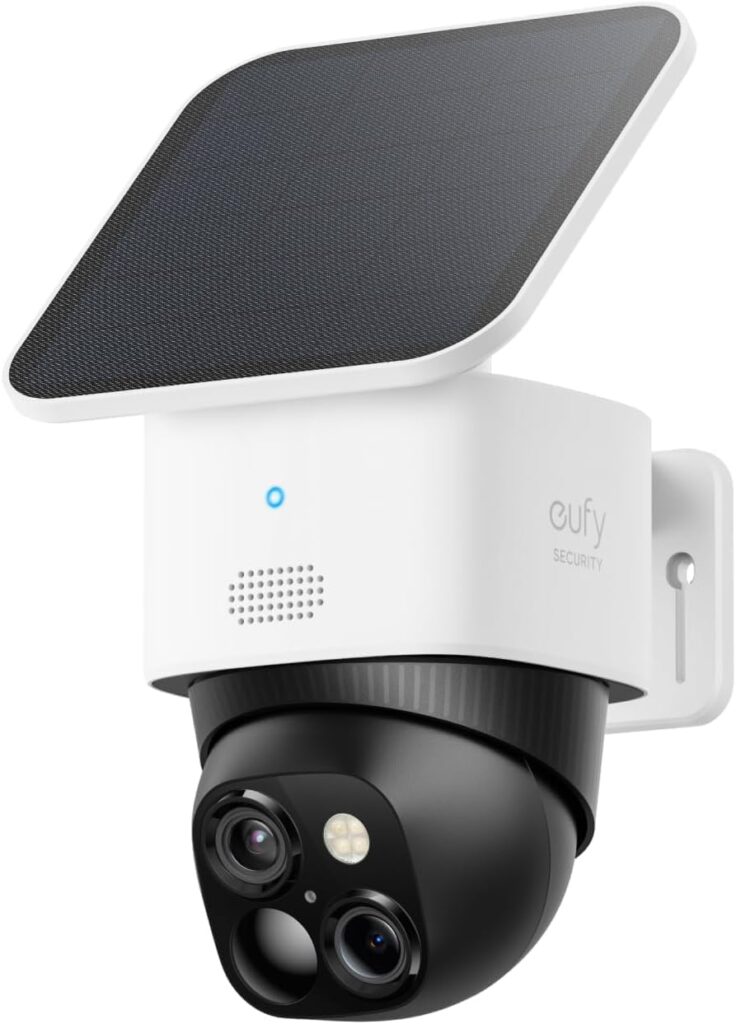
The SoloCam S340 solves three problems that typically force buyers to choose between them: it’s genuinely wireless, it doesn’t need constant sun to stay charged, and it delivers real dual-lens detail rather than a single wide-angle compromise. This review covers what actual field deployments confirm — real solar performance by climate, a documented firmware quirk worth knowing about, and honest ecosystem limitations before you buy.
Full Specifications
| Spec | eufy SoloCam S340 |
|---|---|
| Wide-angle lens | 3K (2880×1620) |
| Telephoto lens | 2K (2304×1296), 8x hybrid zoom |
| Field of view | 135° |
| Pan/tilt range | 360° pan, 70° tilt |
| Battery | Built-in rechargeable, roughly 10,000-13,000mAh (sources vary), up to 3 months standalone |
| Solar panel | 2.2W included, removable |
| Storage | 8GB built-in eMMC, local — no subscription required |
| Weatherproofing | IP67 |
| AI detection | BionicMind on-device AI — people and vehicles |
| Night vision | Color night vision |
| Smart home support | Alexa, Google Assistant — no Apple HomeKit |
| Third-party integration | None — no RTSP, no NAS support, closed ecosystem |
| Price | Typically $199-219 |
The Dual-Lens Design — A Genuine Engineering Advantage

This is the S340’s most significant departure from typical solar PTZ cameras, and independent testing confirms it delivers real practical value: the wide-angle 3K lens captures broad contextual coverage of a yard or driveway, while the 2K telephoto lens with 8x hybrid zoom simultaneously captures close-up detail — a delivery driver’s face, a license plate at 30 feet — that a single-lens camera simply can’t match without sacrificing one view for the other. One year-long US suburban field test specifically confirmed this held up daily across deliveries, package theft attempts, and routine household activity, never losing detail on the moments that actually mattered.
Real Solar Performance by Climate
This is genuinely useful, specific data rather than a generic “solar keeps it charged” claim. In US climate zones south of Pennsylvania, the integrated solar panel reportedly keeps the battery holding between 60-100% year-round. One documented Texas single-family home test found the battery never dropped below 60%, including during cloudy weeks. For buyers in northern or consistently overcast climates, this is worth tempering — the further you are from that southern climate benchmark, the more you should expect periodic manual charging during extended winter cloud cover, similar to the honest winter performance caveats documented on other solar cameras covered on this site.
An Honest Firmware Quirk Worth Knowing
This deserves direct mention rather than being glossed over. At least one detailed independent review specifically flagged a documented firmware issue: a “nighttime Activity Zone override,” where the camera’s custom motion detection zones don’t reliably apply during nighttime hours — a real problem specifically for households near busy roads who’ve configured zones to exclude street traffic, since the override can mean those zones stop filtering correctly after dark. The same source referenced broader “early 2026 firmware failures” as a documented reliability concern, describing it as a reminder that firmware quality can vary. If you’re installing near a road specifically, monitor false-alert frequency after dark for the first week or two and check for firmware updates if the issue appears on your unit.
Real Troubleshooting Data From Field Deployments
One installer who has deployed dozens of these cameras shared the specific, recurring issues worth knowing before you run into them yourself:
“Camera shows offline after 2 hours” — almost always a weak Wi-Fi signal at the install location, typically below -65 dBm. Test signal strength with a phone at the exact mounting spot before installing; if it’s borderline, add a mesh network node or choose a closer location.
“Battery dies in 2 weeks instead of 2 months” — usually caused by motion sensitivity set too high, or the camera positioned facing a busy road that triggers constant recording. Drop sensitivity to 60-70% and define motion zones specifically excluding street traffic.
“Night vision washing out” — typically IR reflection bouncing back from a nearby wall, white siding, or window glass. Reposition the camera by 30-60 degrees to break the reflection angle.
The Honest Ecosystem Limitation
This is worth being direct about: the S340 operates in a closed ecosystem with no RTSP streaming, no NAS integration, and no Apple HomeKit support. If you’re building a self-hosted setup with Frigate or Home Assistant — covered in our best NVR for Home Assistant guide — this camera won’t integrate the way an ONVIF-compliant camera would. For most households simply wanting a capable, subscription-free standalone camera through eufy’s own app, this limitation won’t matter; for smart-home enthusiasts wanting deep third-party integration, it’s a real dealbreaker worth knowing upfront.
Honest Pros and Cons
Pros: Genuinely useful dual-lens design (wide-angle + telephoto with 8x zoom), confirmed strong real-world solar performance in southern/moderate climates, 8GB built-in local storage with zero subscription required, true 360° pan/tilt eliminates blind spots, IP67 weatherproofing, on-device AI detection for people and vehicles
Cons: Closed ecosystem — no RTSP, no NAS, no HomeKit support, a documented nighttime Activity Zone firmware quirk affecting motion filtering near roads, referenced “early 2026 firmware failures” from at least one independent reviewer, battery/solar performance drops meaningfully outside moderate-to-southern US climate zones
Who Should Buy the SoloCam S340
Best for:
- Homeowners and RV owners in moderate-to-southern climates wanting genuinely low-maintenance solar operation
- Anyone specifically wanting simultaneous wide-angle and zoomed detail from one camera
- Buyers prioritizing local storage and zero subscription over deep smart-home integration
Consider alternatives if:
- You’re building a self-hosted Frigate/Home Assistant setup — see our best NVR for Home Assistant guide for ONVIF-compatible options instead
- You’re in a northern or persistently overcast climate — see our Reolink Argus 4 Pro review for honest winter solar performance data on a comparable camera
- Apple HomeKit integration is a requirement
Frequently Asked Questions
How well does the SoloCam S340’s solar panel actually work?
Genuinely well in moderate-to-southern US climates — documented testing in Texas found the battery never dropped below 60% even during cloudy weeks, and climate zones south of Pennsylvania reportedly maintain 60-100% charge year-round. Performance will be more variable in northern or consistently overcast regions, where periodic manual charging during winter is more realistic to expect.
Does the SoloCam S340 work with Apple HomeKit or Home Assistant?
No — it operates in a closed ecosystem with no RTSP streaming, no NAS support, and no Apple HomeKit compatibility. It works with Alexa and Google Assistant through eufy’s own app, but doesn’t integrate with self-hosted platforms like Home Assistant or Frigate.
What is the nighttime Activity Zone issue?
At least one independent review documented a firmware quirk where custom motion detection zones don’t reliably apply after dark, meaning zones configured to exclude something like a busy road may stop filtering correctly at night. This is worth monitoring specifically if your install location is near heavy nighttime traffic — check for firmware updates if you notice increased false alerts after dark.
Why does my SoloCam S340 keep showing offline?
The most common cause, based on real field deployments, is weak Wi-Fi signal at the mount location — typically below -65 dBm. Test signal strength with a phone at the exact spot before final installation, and consider a mesh network node if the signal is borderline.
Does the SoloCam S340 require a subscription?
No — it includes 8GB of built-in local storage with full AI detection and no subscription required. An optional eufy cloud plan is available for those who want off-site backup, but it’s never required for core functionality.
The Bottom Line
The SoloCam S340 earns its reputation as one of the most-recommended subscription-free outdoor cameras through a genuinely useful combination of features rather than one standout spec — dual-lens flexibility, real solar reliability in the right climate, and storage that costs nothing after purchase. The honest trade-offs are real: a closed ecosystem that shuts out self-hosted integration, a documented nighttime firmware quirk, and solar performance that depends meaningfully on where you live. For most households in moderate-to-southern climates wanting a capable, low-maintenance standalone camera, it remains a strong pick.
Check the eufy SoloCam S340 on Amazon →
For the full lineup of subscription-free security cameras, see our best security cameras without subscription guide. For solar-specific camera comparisons, see our best solar security cameras guide.